Buruz
AIRE is an Advanced study of the atmospheric flow Integrating REal climate conditions to enhance wind farm and wind turbine power production and increase components durability
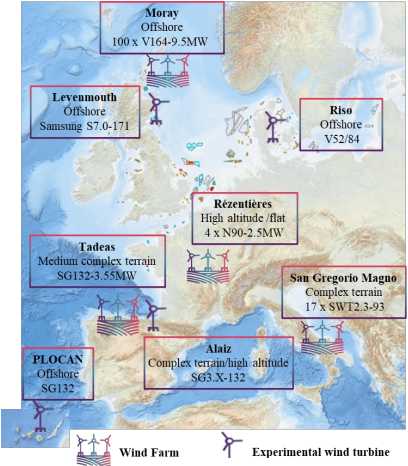
The AIRE project, led by CENER, aims to improve understanding of atmospheric impact on wind energy and provide advanced design tools to maximize efficiency in all weather conditions. The EU has set ambitious targets for long-term structural change in energy systems, requiring larger turbines at higher altitudes and in novel locations. Traditional wind turbine models ignore the physics and aerodynamics of atmospheric wind flows at high altitudes, and do not consider weather conditions like precipitation or sand, which can reduce efficiency and make it harder to predict energy outputs and lifespan of turbines. The AIRE project will investigate the impact of climate conditions in different terrains and altitudes, gathering data from 4 experimental sites and 4 commercial wind farms to develop new numerical models and design tools.
The AIRE project philosophy relies on the gathering of meteorological information in the AIRE project´s sites. With this information, tools and models will be developed and their quality and usability will depend on the measurements’ reliability and traceability. All the measured data will be available in AIRE´s Open Access Knowledge Hub (OAKH). In addition, AIRE project will generate other types of data such as outputs from the models and tool simulations which will also be described in this DMP. The objective of this DMP is to have a reference document to describe and manage all the AIRE´s project data. The DMP will structure all outputs in a coherent way that will be valuable to all the partners and the scientific community in a long term. The partner’s contribution to the DMP will be balanced along the project execution. CENER, as project coordinator will be responsible of the data management and the OAKH set up and maintenance. In addition, CENER, DTU, VTT, OREC, Engie, Capital and Plocan will provide data measured in their experimental or industrial sites to feed the OAKH and so to provide data to the rest of the partners. IWES and DTU will provide data also from their experimental facilities and SGRE will give information to the partners of blade status.
The AIRE project´s sites in which the information will be collected are summarized in the next figure.